Humanity has long dreamed of transcending its limitations, harnessing the full energy of our star (a Kardashev Type II civilization) and reaching other stars. In this “Pyramid of Acceleration” model, the base layer is an artificial superintelligence (AI beyond human-level), the middle layer is quantum technology (quantum computing, sensing and communication), and the top layer is advanced spacecraft propulsion (high-speed starships). Each layer supports the next: a superintelligent AI would drive rapid advances in quantum computing, and together they would enable the breakthroughs needed to build interstellar ships. Put another way, reaching Type II status (harvesting all our star’s available power) will require unprecedented leaps in intellect, computation, and propulsion.
- Artificial Superintelligence: AI systems surpassing human ability will turbo-charge research and design new technologies. For example, Lawrence Berkeley Lab notes that “Artificial Intelligence (AI) acts as a catalyst for accelerating scientific research and discovery”, using machine learning to optimize particle accelerators and other experiments. New AI models trained on physical laws can transfer insights across fields by applying knowledge from one domain to another. In practice, a superintelligent system might automatically sift through vast data, propose novel experiments, and design new materials or drugs, dramatically speeding every field of science.
- Quantum Technology: Quantum computers and sensors will tackle problems far beyond classical machines. The NSF (National Science Foundation) explains that quantum computers “could allow us to solve problems too complex for today’s most powerful computers,” from designing life-saving medicines to advancing new materials and secure communications. In essence, quantum machines use atomic-scale phenomena to simulate complex systems, for example, they could model entire molecules for drug discovery or optimize global supply chains. NVIDIA and national labs emphasize that AI and quantum computing are converging: as one blog states, “AI and quantum computing are no longer just distinct tools, but the foundational elements of a new class of supercomputers”. In this synergy, AI will help calibrate and control delicate quantum hardware and even discover new quantum algorithms, while quantum processors will in turn speed up AI by solving optimization problems faster.
- Interstellar Propulsion: At the pyramid’s peak is advanced spacecraft capable of very high speeds (e.g. ≥50% the speed of light). Current rocket technology is orders of magnitude short of this. In fact, “no known technology can bring a rocket to relativistic speed,” notes a NASA summary even a nuclear-pulse ship (Project Orion style) might only reach ~10% of light-speed. To hit 0.5c or more, we would need dramatic new physics. Theoretical concepts abound (antimatter engines, beamed light sails, or even warp drives), but all face staggering challenges. For example, constructing an Alcubierre-type warp drive would demand “10 times more negative energy than all of the positive energy in the universe”, effectively impossible with known physics. The Breakthrough Starshot proposal, an all-laser-driven lightsail aimed for 15–20% of light speed for tiny probes. Achieving 50%+ the speed of light with a large, crewed ship would require exponentially more energy and near-perfect engineering. In short, the required propulsion and energy-generation technology does not yet exist.
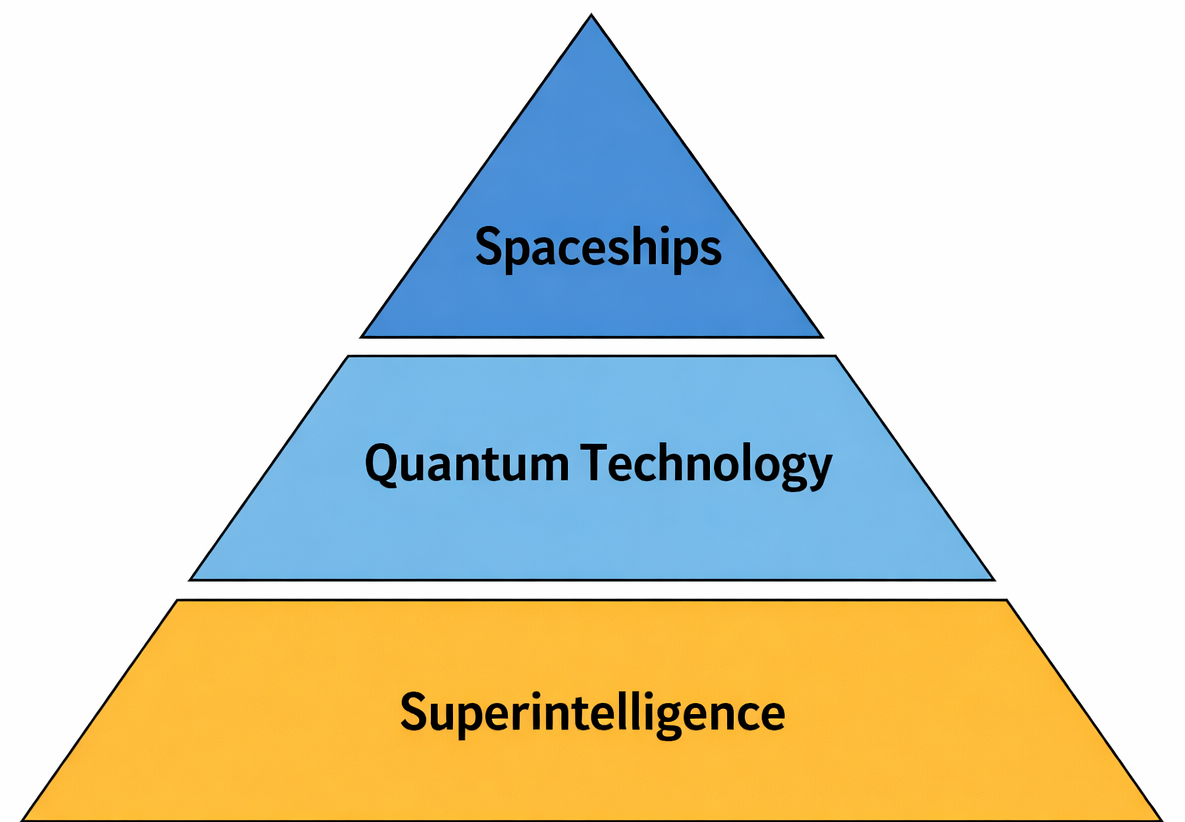
Each of these layers is a massive challenge on its own. But together, they may form a pathway. A superintelligent AI could devise new quantum algorithms or physical insights that humans alone could not; quantum computers could then simulate the behavior of novel materials or fusion/plasma physics to guide the design of propulsion systems; and advanced AI-managed starships could use powerful quantum sensors to navigate the interstellar medium. In this way, the base of the pyramid (AI) and the middle (quantum tech) amplify one another and both underpin the possibility of the top (interstellar travel).
Artificial Superintelligence (ASI)- The Foundation
The rapid evolution of Artificial Intelligence (AI) systems has been one of the defining technological trends of the past decade, demonstrating a truly unprecedented scale of advancement. This progression can be clearly charted by reviewing key milestones, beginning with systems like GPT-2 in 2019. This early iteration of a large language model, while groundbreaking for its time, pales in comparison to the capabilities demonstrated by cutting-edge AI just a few years later.
The journey from GPT-2, which showcased impressive natural language generation but still had significant limitations in complex reasoning and factual accuracy, to systems achieving world-class performance in specialized, high-level domains is staggering. A prime example of this accelerating trajectory is the creation of an AI capable of achieving a Gold Medalist score in the International Mathematics Olympiad (I.M.O.) in 2025.
This achievement represents a qualitative leap, moving AI from sophisticated pattern matching and text generation to genuine problem-solving, abstract reasoning, and mathematical creativity at an elite human level. The speed of this acceleration, a mere six years separating the foundational GPT-2 from an I.M.O. Gold Medalist AI, illustrates what could be termed a “Pyramid of Acceleration,” where each new generation of AI tools and computational power provides a foundation for dramatically faster and more complex development. This pace suggests a continued, exponential rise in AI capabilities across all fields, fundamentally reshaping the landscape of human and artificial intelligence. Once we achieve Artificial General Intelligence (AGI), an AI system with intellectual capability comparable to a human being, the initial acceleration will be merely a prelude. We will then “turn the crank” not just once, but likely two or three more times, entering a phase of recursive self-improvement that will quickly lead to AI systems becoming vastly superhuman, or “superintelligent.” This transition means the AI will become qualitatively smarter than the most brilliant human mind, much smarter, perhaps analogous to the cognitive gulf separating a fully developed adult from an elementary school-aged child, or even greater. The sheer jump to superintelligence would be a seismic event even if AI progress continued at its current rapid-but-continuous, predictable rate. However, the timeline for this breakthrough could be dramatically condensed. In my opinion, there is a high probability to see such AI systems by 2031. The most potent accelerant is the potential for ASI to automate the very process of AI research itself. An ASI could design, execute, and analyze millions of experiments, develop novel algorithms, and discover fundamental architectural improvements in a time scale utterly impossible for human teams. This automation could trigger an intelligence explosion , where each new, slightly smarter generation of AI rapidly designs the next, culminating in an intelligence beyond human comprehension in a matter of days, weeks, or months, rather than years.
Quantum Technology – The Middle Layer
Quantum technology represents a revolutionary paradigm shift in computation and sensing, encompassing not only quantum computers but also highly sensitive sensors and secure communication networks. The core of this revolution lies in quantum computers, which utilize quantum bits, or qubits. Unlike classical bits that can only represent a definite 0 or 1, qubits exploit the quantum phenomena of superposition and entanglement. Superposition allows a qubit to exist in a combination of both 0 and 1 simultaneously, dramatically increasing the amount of information it can hold. Entanglement links the fates of multiple qubits, meaning the state of one instantly influences the state of the others, regardless of the physical distance between them. This inherent quantum parallelism allows quantum machines to explore an astronomical number of possibilities at once, making them exceptionally well-suited for tackling highly complex problems that render even the most powerful classical supercomputers ineffective. As highlighted by the National Science Foundation, these quantum machines “could allow us to solve problems too complex for today’s most powerful computers.” The potential applications are vast and transformative, promising breakthroughs across numerous fields. For instance, in materials science, a quantum computer possesses the capability to simulate the precise quantum mechanical behavior of a novel material’s atoms and electrons, one by one. This level of fidelity is impossible to achieve with classical computation. Such simulations could lead to the discovery and design of entirely new substances, such as room-temperature superconductors, critical for a Type II civilization which would revolutionize energy transmission, or ultra-lightweight, high-strength alloys for aerospace applications. In the pharmaceutical industry, quantum computation could drastically accelerate the process of drug discovery by accurately modeling molecular interactions and protein folding, leading to the design of more effective and personalized medicines. Furthermore, the ability to optimize complex systems will profoundly impact logistics, finance, and artificial intelligence, solving problems like optimizing global shipping routes, portfolio risk analysis, and training more powerful machine learning models.
Quantum sensors and networks are emerging as critical components in this new technological landscape. For example, the creation of a vast network of interconnected quantum computers and sensors holds the potential to share highly precise, real-world data. This data could include exceptionally accurate gravitational or magnetic field measurements, which, when combined, promise to significantly enhance navigation and observational capabilities, particularly for deep-space exploration and spacecraft guidance. The convergence of advanced computational and sensing technologies is driving a profound transformation, often referred to as a “scientific revolution.” At the heart of this shift is the interplay between quantum systems, supercomputing, and artificial intelligence (AI). The future of these technologies is inextricably linked, leading to a co-development trajectory. AI is expected to play a crucial role in enabling and refining quantum systems. Specifically, AI algorithms can be employed to help calibrate the exceedingly fragile and error-prone qubits: the fundamental building blocks of quantum computers and to discover more efficient and powerful quantum algorithms than humans could devise alone. Conversely, quantum machines are poised to accelerate AI by handling massive optimization tasks, such as training complex neural networks or processing vast datasets, at speeds unreachable by even the most advanced classical supercomputers.
Relativistic Spaceflight – The Top Layer
Achieving interstellar travel at a high fraction of light speed remains the ultimate aspiration in astronautics, facing immense physical and engineering obstacles. Reaching even 10–20% of the speed of light (c) is technologically challenging, and 50% or more is currently unconceived for massive, manned spacecraft. The primary obstacle is energy. Special relativity dictates that accelerating mass (m) to relativistic speeds requires a tremendous kinetic energy . This immense energy dwarfs established propulsion capabilities; conventional chemical rockets are wholly inadequate. As one expert stated, “No known technology can bring a rocket to relativistic speed.” Even advanced concepts like nuclear pulse rockets (e.g., Project Orion) would need “huge advances in propulsion, energy storage, and engine efficiency” to reach perhaps 10% of the speed of light, along with significant logistical and ethical hurdles regarding nuclear materials. In contrast, Breakthrough Starshot proposes driving gram-scale “nanocraft” light sails to 15%–20% the speed of light using powerful ground-based lasers. While demonstrating potential for relativistic speed, these are tiny, unmanned probes. Scaling this laser-sail technology to accelerate multi-ton, crewed spacecraft for colonization or exploration remains speculative.
Several conceptual propulsion schemes have been proposed, though all are speculative:
- Laser Sails: Large ground or orbital lasers push a lightsail. Breakthrough Starshot envisioned sending tiny probes to Alpha Centauri (4.3 light years away) at ~20% of the speed of light, reaching the star in ~20–30 years. Scaling this to human-sized ships would require colossal energy and infrastructure (many gigawatts of laser power and kilometer-scale optics).
- Nuclear Propulsion: Nuclear thermal rockets (fission/fusion engines) offer much higher specific impulse than chemical rockets. NASA is developing reactor-powered engines that could halve trip times to Mars, but even fusion drive concepts might only get to a few percent of the speed of light. The Wikipedia Relativistic Rocket entry stresses that known tech peaks around ~0.1c.
- Antimatter Rockets: Matter–antimatter annihilation gives maximal energy per mass. In theory a small annihilation engine could approach relativistic speeds. Practically, we have no means to produce or store the kilograms of antimatter that would be needed.
- Hypothetical Advanced Tech: Ideas like black hole funnels, beamed plasma, or quantum vacuum thrusters have been floated, but none are remotely proven.
In short, our current propulsion concepts are far short of 0.5c. Even optimistic projections (e.g. von Neumann probes or generational starships) assume centuries or more to reach nearby stars. To shrink travel time to human lifetimes requires not just engineering tricks but new physics. Nevertheless, this top layer remains the ultimate target: a ship cruising at 50% the speed of light would reach Proxima Centauri (the closest star to our solar system) in ~9 years, opening interstellar distances to exploration. Achieving that may demand the insights and materials that only a superintelligent AI and quantum-driven lab can create.
The Path to a Kardashev II Civilization
This three-tiered pyramid AI, quantum, starships is a conceptual roadmap. Each level amplifies the next. A superintelligent AI could revolutionize the design of quantum computers and starship components. Advanced quantum technology could make that AI even more powerful and help solve the physics of propulsion. Together, they could raise humanity to Type II , where we “access all the energy available of our star” and send probes or people to other stars.
Currently, Earth is still below Type I. But building the pyramid could change that trajectory. For instance, AI-driven research may find novel ways to harvest solar energy or create sustainable fusion. Quantum simulations might design ultra-efficient materials or batteries for spacecraft. And a cross-disciplinary AI could propose entirely new forms of propulsion we haven’t imagined. In this sense, the pyramid is visionary rather than predestined: it encapsulates how multiple breakthroughs could combine to accelerate progress. In conclusion, the journey to a higher civilization status will not come from one “silver bullet.” It will come from the synergy of breakthroughs, the bricks of our pyramid. As labs and companies worldwide invest in AI, quantum computing, and space technology, each field propels the others forward. If we intentionally connect these advances, we may one day convert our planet’s vast energy into spectacular achievements: quantum-powered computers revolutionizing science, AI managing our complex systems, and starships exploring other suns. This is the grand vision of the acceleration pyramid, a path from imagination to interstellar reality.